As Georgia heads into the final stretch of one of the country’s most closely watched Senate races, the contest is already playing out inside answer engines.
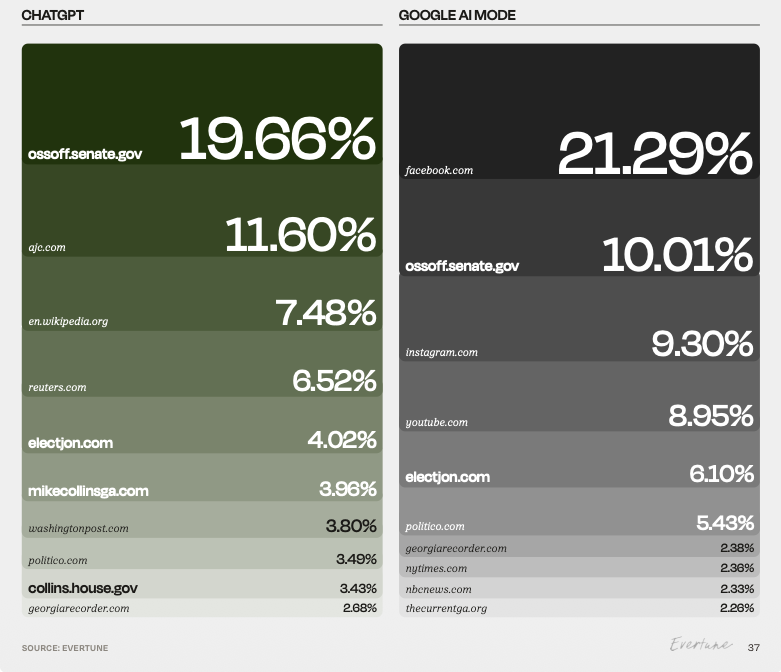
Jon Ossoff’s congressional site is cited by answer engines nearly eight times as often as Mike Collins’s.
That’s one of the clearest findings from our analysis of Georgia’s 2026 Senate race, part of a new report with Evertune on AI and political discovery. Answer engines also cited 71 distinct pages from Ossoff’s site across our sample prompts, compared with nine from Collins’s. And while Ossoff’s official site showed up in all six models we tested, Collins’s appeared in four.
It’s a big gap between two sitting members of Congress with official government websites and active campaigns. With November quickly approaching, the question for campaigns is what’s behind Ossoff’s advantage — and how they can start building one of their own.
Make your site worth citing
Ossoff’s Senate site functions like a reference library for his work and its impact. His Five-Year Report breaks accomplishments into clearly labeled issue areas, with legislation, funding and outcomes separated into specific entries. His “Delivering for Georgia” page goes even further, connecting federal funding to individual counties and recipients.
That means when a model encounters a question about an issue or a Georgia community, it can often find a page on Ossoff’s site that addresses the question directly. It doesn’t have to reconstruct the story from speech transcripts or crawl through dated updates.
On Collins’s site, those kinds of details often sit inside individual announcements. His pages on issues like healthcare, education and the economy, for example, are generally made up of feeds of brief press releases. That gives answer engines a smaller, less consistently organized well of information.
Ossoff’s advantage carries over to the candidates’ campaign sites.* ElectJon.com received more citation share than MikeCollinsGA.com across ChatGPT, Gemini and Google’s two AI answer experiences. The pages that surfaced most often gave answer engines detailed material to work with, including an in-depth biography and a page laying out Ossoff’s position on a corporate housing ban.
If you want the candidate’s positions, history or accomplishments to surface in AI, give them a dedicated home online.
The lesson for campaigns is fairly straightforward: if you want the candidate’s positions, history or accomplishments to surface in AI, give them a dedicated home online. Comprehensive, clearly organized pages give answer engines a more direct path to the information they need to pull from.
Give the news cycle a longer life
The candidates’ own sites are only part of the picture. Local reporting also showed up near the top of the source rankings.
The Atlanta Journal-Constitution was the clearest example in the data. AJC ranked near the top of the overall source results across several models, and on cost-of-living and affordability questions, it accounted for 25.1% of citations in the ChatGPT responses we tested.
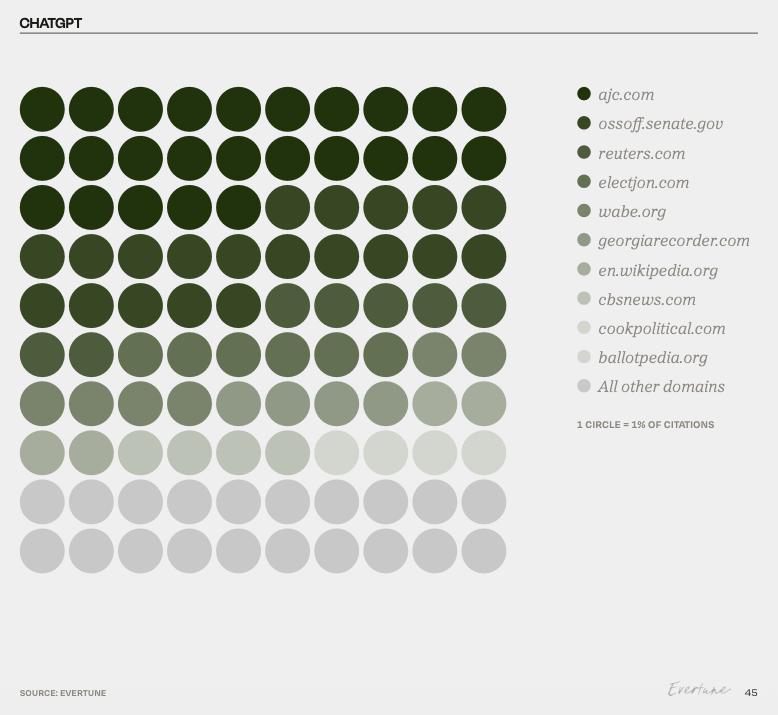
followed by Ossoff’s Senate site.
But what really stood out was the kind of coverage answer engines kept returning to. Among the AJC pages cited most often were candidate hubs and stories explaining where the candidates stand on the economy, healthcare and housing. These are pages that help readers get their arms around the candidates and the issues shaping the race, rather than simply capture what happened on a particular day. That makes them useful source material for answer engines long after the initial news cycle has passed.
The same thing happens with local TV. YouTube plays a prominent role in Google AI Mode and AI Overviews. But many of the channels that surfaced in Georgia actually belonged to news organizations: 11Alive and WSB-TV were among the leading channels in AI Mode, while FOX 5 Atlanta and Atlanta News First appeared in AI Overviews. A segment may air once, but if the clip stays on YouTube, Google can return to it later when someone asks about the candidate or issue it covered.
Help reporters get beyond the announcement.
For campaigns, that changes the media strategy. If an issue is important, help reporters get beyond the announcement by giving them the local stakes, concrete evidence and enough context to explain what the candidate is actually arguing. Those deeper stories can keep resurfacing in AI answers weeks or months later.
Do the work before voters ask
The Georgia findings point to a shift in how campaigns should think about AI visibility. By the time a voter asks ChatGPT or Google about a candidate, the answer engine is working with whatever is already out there.
So what can campaigns do now?
- Give important information a real home. Create detailed, clearly organized pages for priority issues, positions, accomplishments and contrasts.
- Build around the questions voters are likely to ask. Make it easy to understand where the candidate stands, what they’ve done and what it means locally.
- Get specific. Name the legislation or program, include relevant funding amounts and connect actions to communities and concrete results.
- Keep the strongest pages current. Update them as positions develop, new accomplishments emerge or the evidence changes.
- Help reporters tell the fuller story. Give them the local stakes, evidence and context to explain what the candidate is actually arguing and why it matters.
- Think beyond the day coverage runs. Stories that explain an issue in depth can keep resurfacing, and broadcast coverage can have a longer life when full segments remain accessible on YouTube or news sites.
The time to shape the answer is before voters go looking for one.
Read the full Georgia case study in our new report, Winning the AI Vote.
Want to know how your campaign is showing up before November? Campaign Fuel 360: Winning the answer engine race is Orchestra’s pre-midterms AI visibility assessment for campaigns. Get in touch to learn more.
*Campaign and official government websites are managed separately and follow different legal and ethical rules. The report examines the public information available across both and does not assume coordination between them.