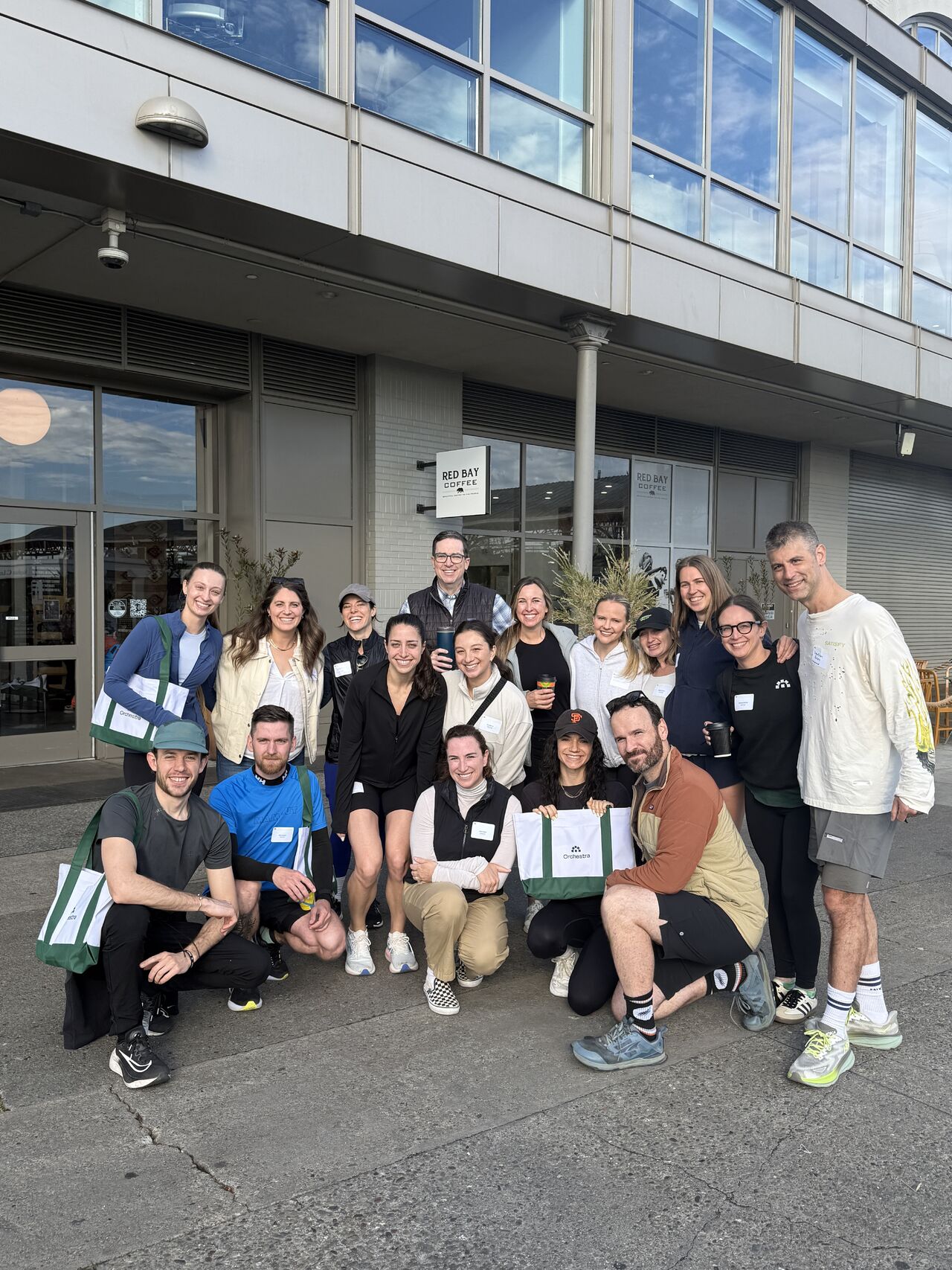
HumanX had the full AI conference starter pack in San Francisco last week: splashy demos, suspiciously healthy green juice and a lot of very serious people wearing very casual sneakers.
Including us. We started day two with an early-morning waterfront run, which ended up being a perfect warmup for the general Moscone Center cardio program.
As we bounced between the expo floor, hallway chats and sessions moderated by some of our favorite journalists, it became clear that the conversation around AI has matured. Last year, a lot of the energy around AI was still about possibility. This year, the questions felt sharper. What is actually working? What is getting in the way? And who, exactly, is supposed to keep all of this under control once it’s live?
Here’s what kept coming up.
The hype phase may be winding down, but nobody is packing up and going home
By now, most people seem ready to skip the “AI is going to change everything” opener and move straight to the nitty-gritty: What are we actually building and who is responsible for making sure it holds up?
That was the real undercurrent of the week. The conversation is now more focused on the practical realities of what companies are doing with AI, where adoption is getting stuck and what needs to change internally to make these systems work in the real world.
AI still drew plenty of excitement, obviously. This is HumanX, not a tax seminar. But it’s clear that the center of gravity has shifted toward execution.
Physical AI kept stealing the spotlight
One idea kept showing up again and again: AI is moving off the screen and into the physical world.
We heard it in conversations about trucks, warehouses, factories, energy systems. These are environments where systems need to be reliable and safe, and where there is a much bigger cost when something goes wrong. A system embedded in real operations has a much higher bar to clear than a chatbot; nobody wants a hallucinating forklift.
For that reason, the excitement around physical AI felt grounded. The biggest question is whether it can work reliably in the messiness of real-world operations.
Infrastructure has become everybody’s business
It’s become hard to escape the reality that all of this takes an enormous amount of infrastructure.
More memory. More storage. More compute. More power. More of all of it.
For a while, these conversations lived mostly with engineers and procurement teams. Now they’re everyone’s problem. The demand curve is steep, and the supply side is feeling it. That gap is shaping what gets built, who can scale and how quickly teams can move from promising prototype to actual deployment.
When it comes to AI, access is starting to matter almost as much as imagination.
Governance took center stage
Governance was another unavoidable topic this year.
Once AI starts touching critical workflows and physical systems, governance stops sounding like paperwork and starts sounding like basic survival instinct. Organizations need clearer ownership, stronger oversight and better answers around what these systems are allowed to do once they're live.
That came up especially in conversations around agents. It is getting easier for teams to spin them up and put them to work, but much harder to set clear rules around what they can access and how they’re managed in practice.
The ability to control these systems is becoming just as important as the ability to build them.
Vibe check
HumanX still had plenty of spectacle. It should. Conferences are part ideas exchange, part endurance sport, part caffeine management exercise.
But the dominant feeling this year was that the industry is getting more serious in a useful way. The smartest conversations were less focused on what AI might become someday and more on what it needs in order to be useful now: infrastructure, governance, real-world applications.
The AI excitement is not cooling off, but it is starting to grow up.